

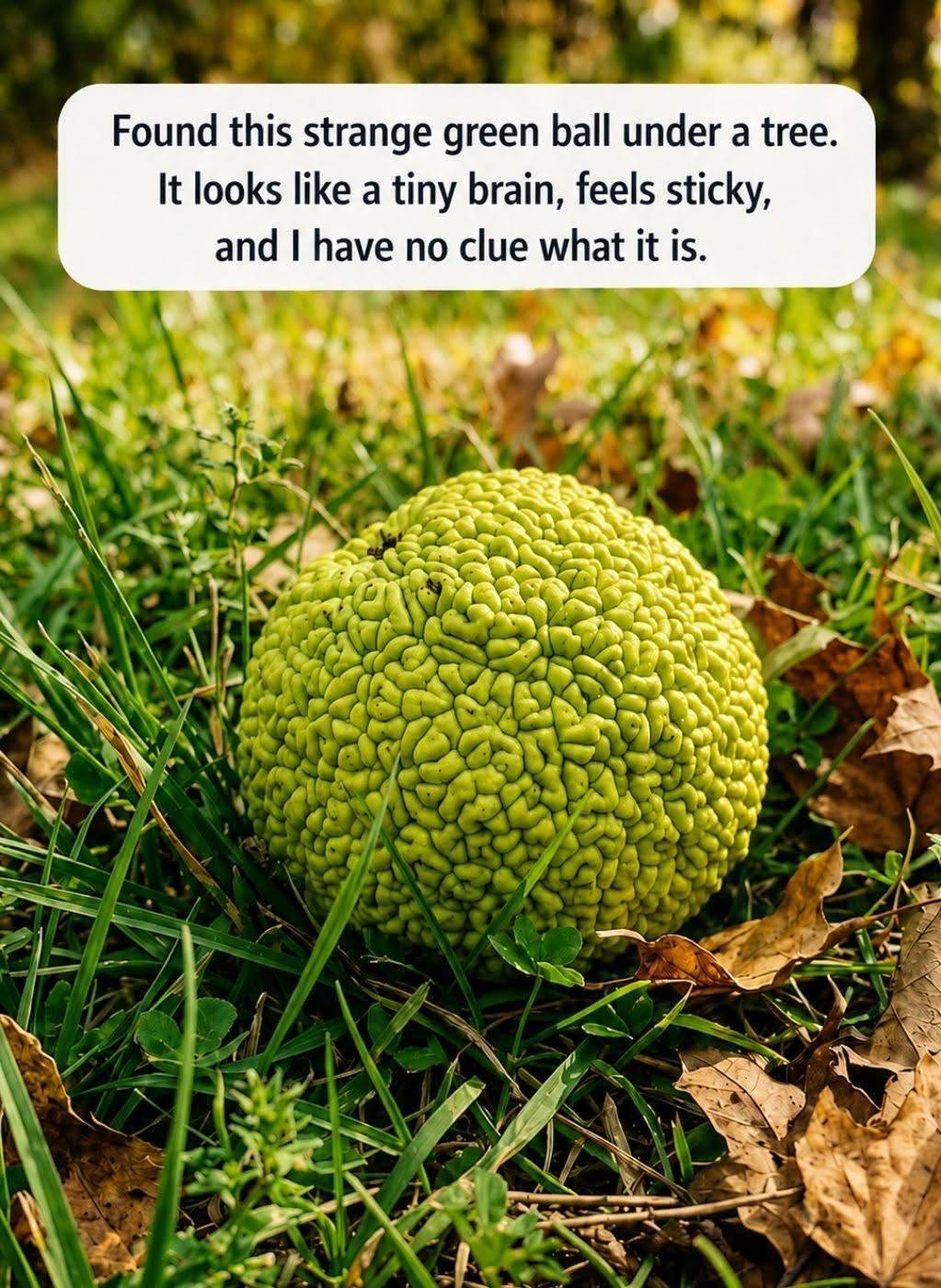
A few falls ago, I was walking near an old fence line when I spotted something that honestly looked fake.
Big. Green. Wrinkled like a brain.
At first I thought it was one of those foam stress balls someone had tossed into the weeds. Then I picked it up and immediately regretted that decision because it was weirdly sticky. Not dripping wet exactly—just tacky in a way that made me want to wipe my hand on my jeans.
If you’ve ever stumbled across one of these strange green balls, you know the feeling. They look like fruit, but not the kind you’d willingly bite into.
Turns out, they’re called Osage oranges. And they’ve been confusing people for generations.
First of All… What Is This Thing?
The Osage orange is one of the strangest fruits native to North America.
It grows on a rugged tree called Maclura pomifera, mostly around parts of Texas, Oklahoma, Arkansas, and neighboring states—although these days you’ll find them scattered all over the Midwest and beyond. Old farms especially. Fence rows too.
And the fruit itself? It barely looks real.
It’s usually about the size of a softball, sometimes larger, with a deeply wrinkled surface that looks uncannily like the folds of a brain. Bright green at first, then yellow-green as it ages. Heavy, oddly dense, and a little awkward to hold.
Honestly, nature was feeling experimental with this one.
Why Does It Look So… Bumpy?
That brain-like texture isn’t random.
An Osage orange isn’t technically a single fruit the way an apple is. It’s actually a cluster of many tiny fruit structures packed tightly together. As they grow, they swell unevenly and create all those strange folds and ridges.
The result looks less like produce and more like something washed ashore after a storm.
And then there’s the sap.
If you break one open—or even scratch the surface—you’ll notice a white sticky substance inside. Kind of milky. Kind of gluey. It’s latex-like sap, and while it’s not dangerous, it definitely feels unpleasant on your hands.
Not gonna lie, the first time I touched one, I thought: this cannot possibly be edible.
Which, as it turns out, is mostly correct.
Can You Eat an Osage Orange?
Technically, it’s not poisonous.
But “edible” is doing a lot of heavy lifting here.
The fruit is incredibly fibrous, bitter, and packed with sticky sap. Most people who try it describe it as somewhere between “inedible” and “absolutely not.”
Even animals mostly avoid the flesh.
Squirrels sometimes tear into the fruit to get the seeds, but that’s about it. Humans? We generally leave them alone unless we’re trying to win a dare or impress somebody at a bonfire with weird plant trivia.
The Wildest Part? Ancient Animals Probably Loved Them
This is where the story gets unexpectedly fascinating.
A lot of scientists believe Osage oranges are basically leftovers from prehistoric North America.
Seriously.
The theory is that massive Ice Age animals—things like giant ground sloths or mammoths—used to eat these fruits whole. Those animals were big enough to crush the tough fruit and spread the seeds across huge distances.
But once those animals disappeared, the trees kind of lost their ideal seed-spreading partners.
Which honestly explains a lot. Because the fruit feels designed for a creature with a jaw the size of a car tire.
Not a squirrel.
The Tree Itself Is Tough as Nails
The fruit gets all the attention, but the tree behind it is impressive too.
Osage orange trees are hardy, thorny, and stubborn in the way old farm trees tend to be. They handle drought well, tolerate poor soil, and can grow into dense, tangled barriers.
Before barbed wire became common, farmers actually planted rows of these trees as living fences. And apparently they worked surprisingly well because the branches are packed with long, nasty thorns.
Cows generally got the message.
NEXT PAGE