

The wood is another story entirely. Dense, heavy, almost ridiculously durable. Native American tribes, especially the Osage Nation, prized it for bow-making. Some people still call it “bodark” wood—a shortened version of bois d’arc, French for “wood of the bow.”
And if you’ve ever tried splitting seasoned Osage wood for firewood… good luck. That stuff fights back.
Okay, But Do They Really Repel Spiders?
You’ve probably heard this one.
People put Osage oranges in basements, garages, corners of rooms—supposedly to keep spiders away.
My grandmother believed this with absolute confidence. Every fall she’d collect a few and place them around the house like seasonal decorations with a side of pest control.
Science, though, is less convinced.
The fruit does contain compounds that insects seem to dislike somewhat, but there’s very little evidence that simply placing whole fruits around your home does much of anything.
So if you like the tradition, sure. Go for it.
But if you’ve got an actual spider problem, you’ll probably need something stronger than a wrinkled green fruit from the yard.
They Smell Better Than They Look, Weirdly Enough
This surprised me.
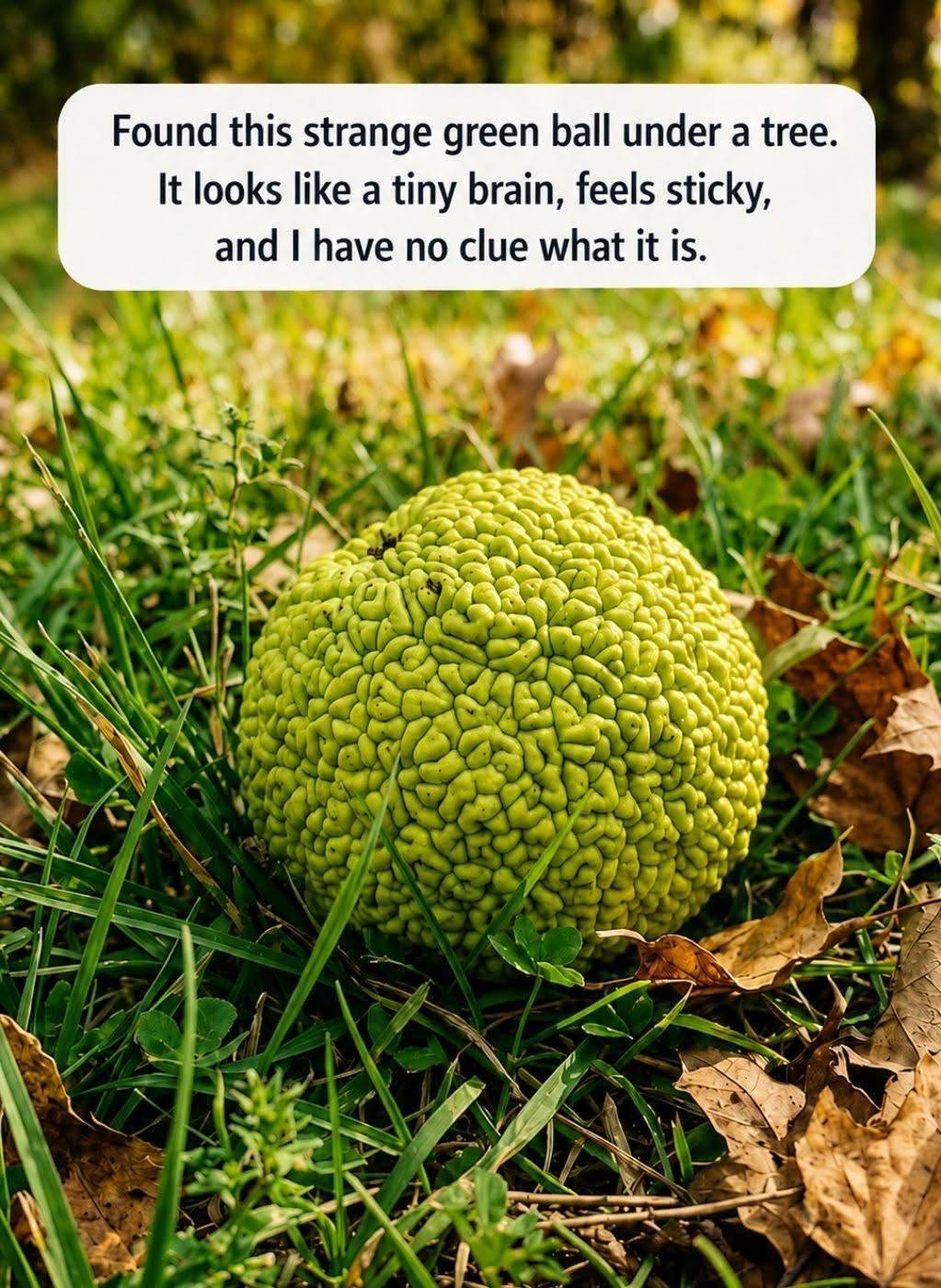
For something that resembles a mutant softball, Osage oranges actually have a mild citrusy smell when fresh. Not strong. Not exactly pleasant either. Just… cleaner than expected.
Some people love the scent. Others say it smells vaguely like cucumbers mixed with grass.
Either way, it’s less offensive than you’d think.
The sticky sap is still annoying though. That part never improves.
People Mistake Them for Other Things All the Time
Black walnuts are probably the most common mix-up.
Both are green. Both fall from trees. Both look strange enough that people hesitate before touching them.
But black walnuts are smoother and usually smaller. Osage oranges look dramatically more wrinkled—almost sculpted.
Once you’ve seen one up close, you really don’t forget it.
So What Should You Do If You Find One?
Honestly? Nothing.
Leave it there if wildlife is around. Use it as decoration if you want. Some people collect them for autumn centerpieces because they definitely spark conversation.
Kids usually think they’re hilarious.
Just maybe don’t mow over them.
A lawnmower hitting an Osage orange sounds alarmingly close to a small explosion. Learned that one the hard way.
Final Thought: Nature Makes Some Truly Strange Stuff
That’s probably why people love finding these things.
An Osage orange looks like something halfway between fruit, alien artifact, and science experiment. It doesn’t fit neatly into what we expect nature to look like.
And maybe that’s the charm of it.
You spot one lying in the grass and immediately have questions.
What is this thing?
Why does it exist?
Who looked at this and thought, “Yeah, let’s call it an orange”?
Honestly, fair questions.