
- Objects hidden inside other objects
- Changes in orientation
- Repeated patterns
- Shapes that don’t quite belong
That experience can make the search faster.
It doesn’t mean their brain is younger.
It means they’ve learned how to play the game.
Try Looking at the Image Differently
If you’re struggling to find the man in the hat, don’t simply stare harder.
Change the way you look.
Step Away From the Image
Sometimes looking from farther away can make larger shapes easier to recognize.
Scan the Whole Picture
Don’t focus on one small area.
Move your eyes systematically across the entire image.
Look for Shapes Instead of Objects
Instead of asking what each part represents, look at outlines, curves, spaces, and contrasts.
Pay Attention to the Background
The hidden figure may be disguised as part of the environment.
What looks like scenery could actually be contributing to the man’s outline.
Take a Short Break
If you’ve been staring at the same image for several minutes, look away briefly and return to it.
A fresh look can sometimes help you notice a pattern you previously overlooked.
Why the “Aha!” Moment Feels So Satisfying
There is something incredibly satisfying about finally spotting a hidden figure.
For several moments, you’re convinced the answer isn’t there.
Then your brain suddenly makes the connection.
Click.
The image makes sense.
And once you’ve seen the man, you may find it almost impossible to return to the way you saw the picture before.
That’s one of the pleasures of visual puzzles.
They don’t necessarily give you new information.
They give you a new interpretation of information that was already there.
Are Hidden-Object Puzzles Good for Your Brain?
They can certainly be entertaining and encourage you to pay attention to visual details.
They may involve skills such as visual search, pattern recognition, and selective attention.
But it’s important not to turn a casual puzzle into a medical test.
Successfully completing one hidden-object challenge doesn’t establish that your brain is healthy or young, just as taking longer doesn’t establish that something is wrong.
Enjoy the puzzle for what it is:
A fun visual challenge.
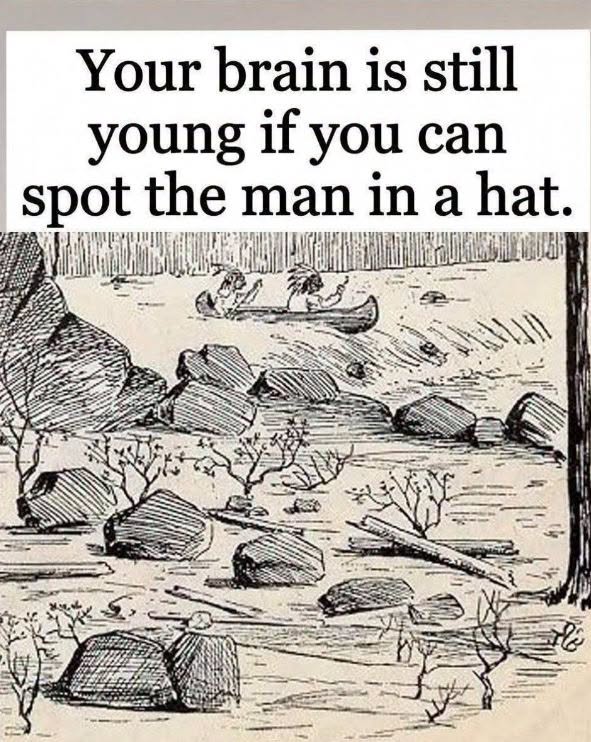
So, Can You Find the Man in the Hat?
Now it’s your turn.
Take another look at the image.
Don’t let the surrounding patterns distract you.
Don’t assume the most obvious shapes are the only important ones.
Move your attention around the picture.
Look at the relationships between the shapes rather than focusing only on individual objects.
And give your brain a moment to reorganize what you’re seeing.
You may suddenly have that wonderful moment when the hidden figure appears.
“Wait… how did I not see that before?”
That’s the magic of the puzzle.
Frequently Asked Questions
Does finding the hidden man mean my brain is young?
No. Finding the figure quickly isn’t a scientifically valid way to determine your brain’s age or overall brain health.
Why can’t I see the man in the hat?
The figure may blend into surrounding shapes and patterns. Your attention may also be focused on more obvious parts of the image.
Why can I see the hidden man after someone points him out?
Once you know what pattern you’re looking for, your brain has additional information for interpreting the same visual details.
Does everyone see hidden images the same way?
Not necessarily. People can differ in attention, visual experience, familiarity with puzzles, and how quickly they recognize particular patterns.
Are hidden-object puzzles a test of intelligence?
Not in any simple or definitive sense. They can involve visual search and pattern recognition, but one puzzle cannot measure overall intelligence.
Can these puzzles determine my brain age?
No. A viral hidden-object puzzle isn’t a clinical or scientific brain-age assessment.
Why do hidden figures become obvious after you see them?
Once the relevant pattern has been recognized, your brain can use that interpretation when looking at the same shapes again. What previously seemed like unrelated details can suddenly form a coherent figure.
Final Thoughts
The next time you see a viral puzzle claiming that your brain is still young if you can find the hidden man, have some fun with it—but don’t take the headline literally.
The real story is much more interesting.
Your brain is constantly filtering enormous amounts of visual information, deciding what deserves your attention and what can safely fade into the background.
A hidden-object puzzle simply turns that everyday process into a game.
So look carefully.
Change your focus.
Search for patterns.
And when the man in the hat finally appears, enjoy that little aha! moment.
Because sometimes the most fascinating thing about a picture isn’t what your eyes can see.
It’s what your brain decides to notice.