
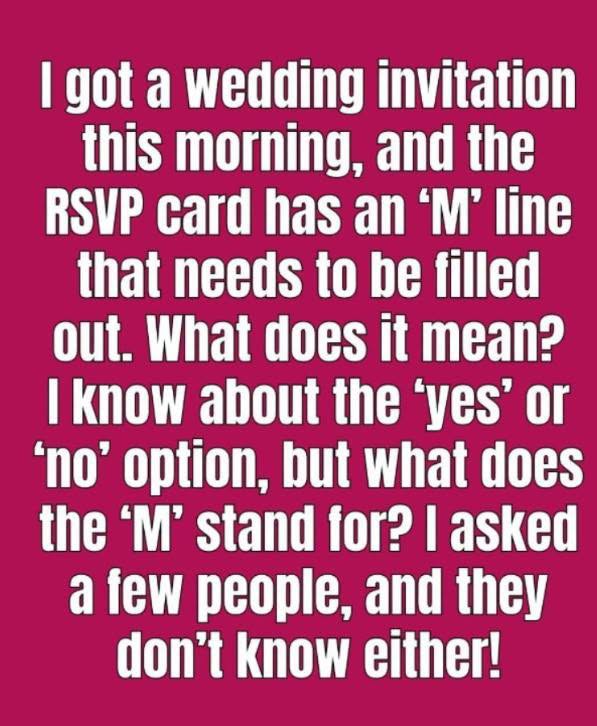
If you’ve ever opened a wedding invitation, birthday invitation, or formal event invitation and paused at the RSVP section, you’ve probably noticed a tiny “M” sitting right before a blank line.
And if you’ve ever thought, Wait… what exactly am I supposed to write there? — you’re definitely not alone!
That little letter has confused plenty of people over the years.
The good news?
It’s actually pretty simple once you know what it means.
What Does the M Mean on an RSVP Card?
The “M” on an RSVP card traditionally stands for the first letter of your courtesy title.
In other words, the invitation is asking you to write the beginning of your title before your name.
For example:
- Mr. John Smith
- Mrs. Jane Smith
- Ms. Emily Smith
- Miss Sarah Smith
- Dr. Michael Smith
So if an RSVP card says:
M __________
you would traditionally complete it with your title and name.
For example:
M Mr. John Smith
The “M” is essentially a little prompt indicating that your response should begin with a title.
Why Is There an M on the RSVP Card?
This tradition comes from older formal invitation etiquette.
The idea was that the guest would write their appropriate courtesy title—such as Mr., Mrs., Miss, or Ms.—followed by their name.
Over time, the format became so common that many stationery designers simply printed the M as a shorthand prompt.
It can look strange today because modern invitations aren’t always as formal as they once were.
But the tradition stuck around.
And that’s why you may still see it on wedding RSVP cards today.
What Should You Write After the M?
Simply write your appropriate title and name.
If You’re a Man
You would generally write:
Mr. John Smith
If You’re a Married Woman Using Mrs.
You might write:
Mrs. Jane Smith
If You Use Ms.
You can write:
Ms. Jane Smith
If You’re a Doctor
If you normally use your professional title, you may write:
Dr. Emily Smith
The important thing is to use the title you actually use or prefer.
What If You Don’t Use a Title?
This is where modern etiquette gets a little more flexible.
If you don’t identify with a traditional courtesy title, you don’t necessarily need to force yourself into one just because the RSVP card begins with an “M.”
Depending on the design of the card, you can simply write your name in the available space.
If the form is clearly designed around traditional titles but doesn’t accommodate your preferred name format, writing your full name neatly is usually the simplest solution.
The goal is to make it clear who is responding.
What If the RSVP Says “M_____” and I’m Responding for Two People?