

“I am.”
That made her laugh.
And I realized I had been waiting for that sound.
Not as her boss.
Not as the man whose name was on the wall.
As Evan.
Just Evan.
That was the beginning of a different kind of problem.
Because outside work, conversations between us became easier than they should have.
It started after late meetings, when the building had gone quiet and neither of us seemed ready to go home.
We talked in the lobby while the cleaning crew moved around us.
Then we talked outside near the river, standing with paper
cups of coffee from a corner diner that had been open since the 1970s.
No romance at first.
No big moment.
Just two lonely people who had both mistaken survival for strength.
She told me about Ohio.
About her mother, Linda, who kept insisting she was fine even when lifting a coffee mug still tired her out.
About Caleb, who put on a brave face and fixed trucks all day, then called Maya at night pretending he just wanted to talk about baseball.
About the shame of needing money and the pride of refusing pity.
I told her about my divorce.
Not in detail.
Not with blame.
Just the truth.
I had become easier to admire from far away than to love up close.
I told her about my father, who built the company from a small regional carrier and taught me that work was how men proved they were
worth keeping.
I told her about the years after I took over, when I believed silence made me fair.
When really, silence made other people guess what I valued.
And people like Clare filled in the blanks.
One evening, after a long meeting about the new frontline review board, Maya and I walked through a small park near the river.
The city lights trembled on the water.
Her shoulder brushed mine once.
Neither of us spoke for half a block.
Then she stopped.
“Evan.”
I turned.
She almost never used my first name at work.
Outside work, it still felt new.
“We have to be careful.”
“I know.”
“I mean it,” she said. “I cannot become a story people tell about the CEO and the girl he rescued.”
“You rescued yourself.”
“Maybe,” she said. “But people like simple stories. They’ll make one if we let them.”
She was right.
She
was usually right.
“I don’t want your power,” she said. “And I don’t want to be protected by it.”
“I don’t want that either.”
Her eyes searched mine.
“I like you,” she said.
The words were simple.
They moved through me like something I had been waiting years to hear.
“I like you too,” I said.
“But I need my name to stand on its own first.”
“It already does.”
“To me,” she said. “Maybe to you. But not to everyone else yet.”
So we waited.
Not because feeling was absent.
Because respect was present.
At work, she was Miss Bennett.
An analyst in a division that did not report to me.
I was Mr. Hartwell.
Distant.
Professional.
Careful.
Outside work, over time, we became Evan and Maya.
Coffee with no titles.
Walks through Chicago neighborhoods where nobody cared who owned what building.
Breakfast at a diner where she ordered
pancakes for dinner because, as she put it, “adulthood has taken enough from me.”
Phone calls with her mother, who called me “that quiet man” for six months.
A road trip to Ohio, where Caleb shook my hand too hard and later told Maya I seemed “less terrible than expected.”
I took that as high praise.
One year later, Maya earned a strategy role in a separate division.
A real promotion.
A real process.
A real panel.
Her name stood on its own.
The announcement went out on a Tuesday.
I read it alone in my office.
Maya Bennett promoted to Strategy Operations Lead.
No mention of me.
No shadow of me.
Just her work.
Her results.
Her name.
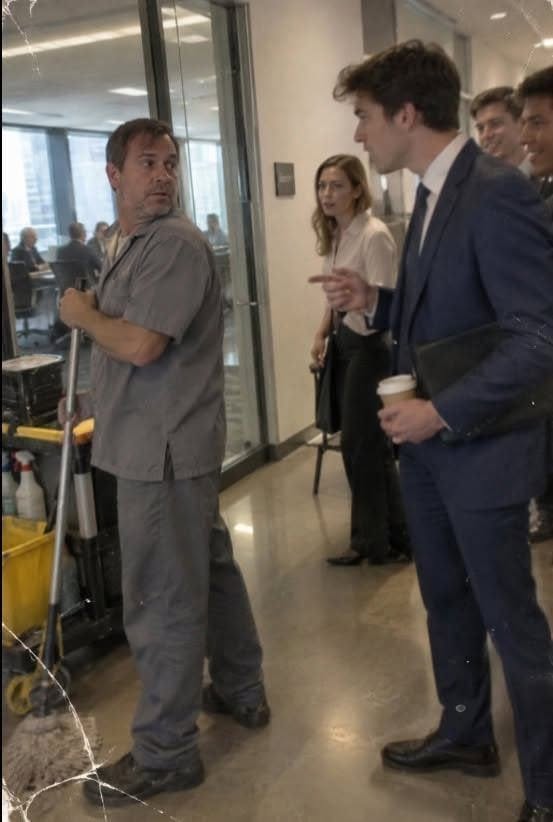
That evening, I found her in the hallway where we had first met.
A wet floor sign stood nearby.
A wet floor sign stood nearby.
Walt had placed it there and
then disappeared, though I suspected he was watching from somewhere with great satisfaction.
Maya looked at the sign.
Then at me.
“That whole week,” I said softly, “you were the only person who saw me.”
She shook her head.
“No.”
I smiled.
“No?”
“I saw a tired man who needed help,” she said. “The title came later.”
That was Maya.
She could cut through a man’s pride with one clean sentence and make him grateful for it.
Outside, Chicago shimmered under a light evening rain.
Through the glass doors, employees moved through the lobby.
Some in suits.
Some in uniforms.