

life?”
“Only on weekdays,” I said.
Despite herself, she almost smiled.
Then her face broke.
“I thought if I worked hard enough, it would be enough,” she said. “If I stayed decent. If I didn’t play games. But maybe in places like this, being decent just makes it easier for people to step over you.”
I sat one step below her, leaving space between us.
“No,” I said. “That’s what places like this want you to believe.”
She looked at me.
“The problem isn’t that you’re kind,” I said. “The problem is a system that punishes people who refuse to perform.”
She studied my face.
“You talk like you know that system.”
I looked through the narrow stairwell window.
Beyond it, Chicago moved like nothing inside one office tower could matter.
“I do.”
“Ed,” she whispered, “who are you?”
For the first time all week, I almost told her.
Not
because I wanted to impress her.
That was the strange part.
With everyone else, my name was power.
With Maya, it felt like a burden.
If I said Evan Hartwell, every honest thing she had said to me would change shape.
She would replay every word.
Every moment.
Every kindness.
And she would wonder if I had been testing her.
I had been.
That was the truth I hated most.
So I did not tell her.
Not yet.
“I’m someone who should have noticed sooner,” I said.
Her eyes filled, but she did not let the tears fall.
“Noticed what?”
“How many good people this place has taught to lower their voices.”
By noon, I was no longer only observing.
In a locked security office, I reviewed footage from the networking event.
No drama.
No spin.
Just the plain record.
Tyler’s comments.
Maya kneeling to clean a spill he had
turned into a joke.
Clare watching.
The executives looking away.The executives looking away.
By 2:00, I had access to the shared project document history.
Maya’s name removed from the core analysis.
Tyler’s name placed over it.
Maya’s work renamed and polished until theft looked like leadership.
By 3:30, I read internal messages between Clare and two senior managers.
They were not explosive.
That would have been easier.
They were worse because they were ordinary.
Tyler photographs well for the program.
Maya may be reactive under pressure.
Keep Walt’s complaint contained unless it resurfaces.
Contained.
I stared at that word for a long time.
That was what they called people when they became inconvenient.
Not wrong.
Not wounded.
Not ignored.
Contained.
Walt had been contained.
Maya was being contained.
And if I kept trusting clean reports from people who benefited from dirty rooms, then I was not an
observer.
I was part of the machine.
At 4:15, I called my board chair.
“I need you in the trainee presentation tomorrow morning,” I said.
She paused.
“Evan, I thought you were traveling this week.”
“I was closer than you think.”
Another pause.
“What did you find?”
I looked through the security office window at the trainee floor.
Maya stood near the printer, shoulders squared, reading over notes she had every reason to throw away.
“I found the cost of my absence,” I said.
Friday morning arrived with polished floors, fresh coffee, and a conference room full of people who still believed the week had gone exactly as planned.
The board sat along one side of the long table.
Senior executives filled the other.
Clare stood near the screen, calm and elegant.
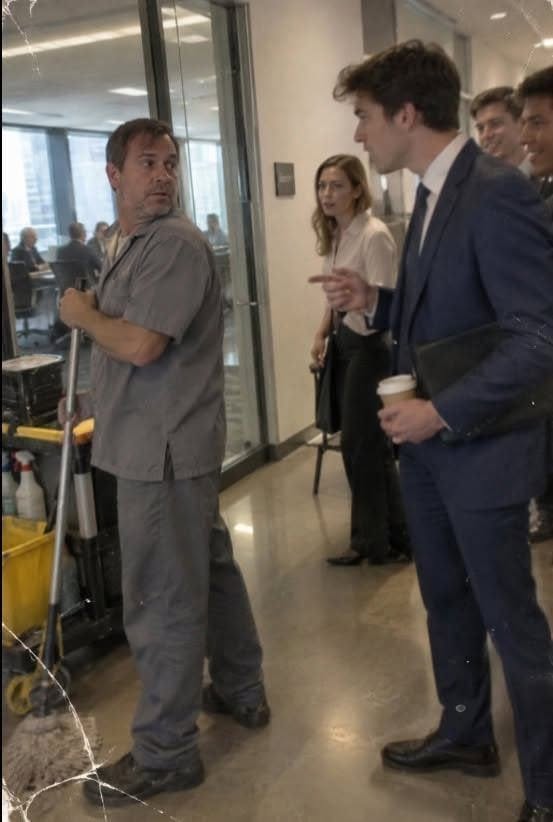
Tyler waited beside her in his navy suit.
Maya sat in the second row with her folder
on her lap.
She could have stayed home.
No one would have been surprised.
After Clare’s red mark in her file, leaving quietly would have made sense.
But leaving quietly felt too much like agreeing.
Tyler began his presentation with confidence.
“Our proposal addresses Midwest delivery inefficiency through predictive route correction and cross-department synchronization.”
His slides were beautiful.
So beautiful they almost hid the theft.
Maya listened as he explained weather delays, driver penalties, warehouse bottlenecks, and feedback loops from frontline workers.
Her words came back to her in sharper fonts.
Cleaner language.
A better suit.
Clare smiled proudly.
Then board chair Margaret Ellis leaned forward.
“Mr. Reed, what practical experience supports this recommendation? Have you worked directly with drivers or warehouse teams?”
Tyler paused for less than a second.
“We consulted internal performance data,” he said. “And we considered field realities from a strategic perspective.”
It sounded good.
It
meant almost nothing.
Maya felt her heartbeat in her throat.
She thought of the drivers blamed for routes no one could complete.
Warehouse teams blamed for schedules they did not design.
Walt’s complaint buried in a folder.
Ed, sitting beside her in the stairwell, telling her not to mistake silence for maturity.