

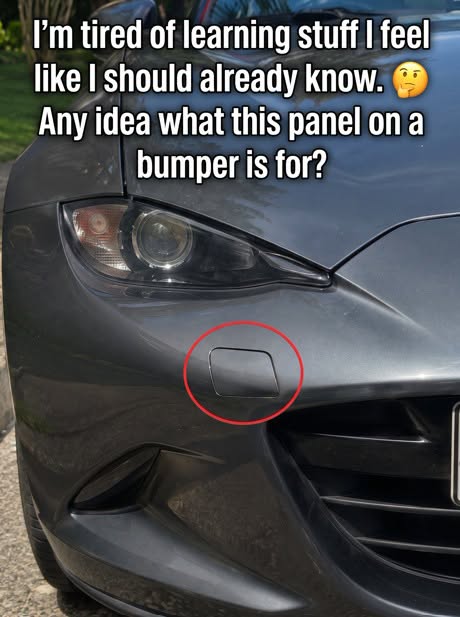
Your owner’s manual can help you identify the correct location.
Step 2: Remove the panel
Many tow hook covers can be released by gently opening a small notch with a suitable plastic trim tool.
Some designs have a different release mechanism, so check your owner’s manual before attempting to remove yours.
Avoid forcing the panel open with a screwdriver or other hard object. It’s easy to scratch the paint, damage the retaining clips, or crack the cover.
Step 3: Find the towing eye
On many cars, the removable towing eye is stored with the vehicle’s tools, such as in the trunk or under the cargo floor.
The location varies, so check the manual if you can’t find it.
Step 4: Install the towing eye correctly
If your vehicle uses a screw-in towing eye, it must be threaded into the designated socket according to the manufacturer’s instructions.
It should engage properly and be secured as specified. Never use a partially threaded or incorrectly fitted towing eye for recovery.
Step 5: Attach the appropriate towing equipment
Once the towing point is correctly installed, a qualified recovery operator can attach suitable equipment according to the vehicle manufacturer’s instructions.
The designated point helps direct towing forces to an engineered mounting location rather than an unsuitable part of the bumper.
One important distinction: a towing eye is not automatically suitable for every kind of towing or vehicle recovery. Some vehicles have different arrangements, and pulling a vehicle out of deep mud or snow can place much greater forces on the mounting point than ordinary towing.
Always follow the vehicle’s instructions.
Why Don’t Car Manufacturers Leave the Tow Hook Exposed?
That’s a good question!
If the towing point is so useful, why hide it behind a little plastic panel?
There are several practical reasons.
It keeps the bumper looking clean
Modern vehicle design often favors smooth surfaces, flowing lines, and minimal visible hardware.
A removable cover allows manufacturers to include access to a towing point without leaving a prominent metal hook sticking out of the bumper.
It protects the access point
The cover helps keep dirt, road debris, and moisture away from the opening when the towing eye isn’t installed.
It doesn’t make the socket completely waterproof, but it provides a useful protective barrier.
It avoids unnecessary protrusions
An exposed towing point can stick out from the vehicle’s bodywork. A flush cover keeps the bumper’s exterior relatively smooth when the towing point isn’t needed.
The result is a practical feature that remains out of sight during everyday driving.
When Would You Actually Use the Hidden Tow Hook?
Here’s where this little feature becomes especially useful.
Imagine your car stops working on a narrow road, your vehicle needs to be moved after a breakdown, or you find yourself stranded somewhere a recovery truck needs to access your car.
The designated towing point may allow the recovery operator to connect suitable equipment to the vehicle.
Common situations include:
Your car breaks down
If the engine fails or the vehicle becomes undriveable, a recovery operator may need to move it to a safe location.
The towing eye may provide an approved attachment point, depending on the vehicle and the recovery procedure.
Your car needs to be moved from a difficult position
A vehicle may need to be repositioned when it can’t move under its own power.
The appropriate recovery point can help an operator move it safely when the manufacturer’s instructions permit that method.
Your vehicle is stuck in snow or mud
This situation requires extra caution.
A designated towing eye may be suitable for certain recovery procedures, but pulling a stuck vehicle free can generate substantial forces.
Not every towing point is designed for heavy-duty extraction, and sudden jerking or using an unsuitable strap can cause serious damage or injury.
When a vehicle is deeply stuck, professional recovery equipment and an experienced operator are often the safest choice.
Your car needs to be loaded onto a transport vehicle
Depending on the car’s design, a towing eye or another designated point may be used during certain loading or positioning procedures.
The correct method depends on the vehicle, its drivetrain, and the manufacturer’s guidance.
Can You Tow a Car Using Its Bumper?
You should never assume the bumper itself is a safe towing attachment point.
Modern bumpers often contain plastic exterior panels, energy-absorbing structures, and other components that aren’t intended to withstand towing forces.
Pulling directly on the bumper, suspension parts, axle components, or other unsuitable locations can damage the vehicle.
That’s one reason manufacturers provide designated towing or recovery points.
However, the removable towing eye isn’t necessarily designed for every possible towing situation either. Its permitted use may be limited to specific procedures, such as moving the vehicle a short distance or loading it for transport.
For example, some vehicles require flatbed recovery, while others have special procedures for all-wheel-drive or electric vehicles.
The owner’s manual should always take priority over general advice.
Is the Tow Hook Cover on the Front or Rear of the Car?
It depends on the vehicle.
Some cars have a tow hook access panel on the front bumper, others have one on the rear bumper, and some have access points at both ends.
The location may depend on the vehicle’s design and the manufacturer’s intended towing procedures.
Don’t assume that a front towing point can be used for every recovery situation or that the rear bumper contains an identical fitting.
If you need to locate the towing eye in an emergency, check your owner’s manual before removing any panel.
What If Your Car Doesn’t Have a Little Square Panel?
Not every vehicle uses the same design.
Some cars have a round cover instead of a square one. Others have a differently shaped panel, a more concealed access point, or another towing arrangement.
Certain vehicles may use fixed towing eyes or designated recovery points that don’t require a removable bumper cover.
Electric vehicles and some specialized vehicles can also have specific recovery requirements.
So if you can’t find a small square panel, don’t assume your car has no towing provision.
Check the owner’s manual for the correct towing or recovery procedure.
Is It Safe to Remove the Tow Hook Cover Yourself?
In most cases, removing an ordinary tow hook cover for inspection is straightforward, provided you follow the manufacturer’s instructions.
However, there are a few things worth remembering.
- Use the recommended release method or tool.
- Avoid forcing the cover or scratching the surrounding paint.
- Keep the cover and its retaining clips in good condition.
- Replace the cover properly after inspection.
- Never crawl beneath a vehicle that isn’t securely supported.
- Don’t attach a rope, chain, or strap to an unidentified component.
If you discover that the cover is broken, missing, or difficult to remove, consult your owner’s manual or ask a qualified technician for help.
And if you actually need to tow or recover the vehicle, make sure the designated point is appropriate for that specific procedure.
What About the Small Panel on the Rear Bumper?
It may serve the same general purpose, but you shouldn’t assume every panel on a bumper is a tow hook cover.
Some vehicles have separate covers for other components, including parking sensors, lighting access, or other service points.
A rear bumper may also contain a towing access point, but the only reliable way to identify a particular panel is to check the vehicle’s manual or confirm its purpose with a technician.
If you’re unsure, don’t pry it open simply because it looks similar to a known tow hook cover.
Frequently Asked Questions
What is the small square plastic cover on my car’s bumper?
It’s often a tow hook cover. It conceals an access point for a removable towing eye or another designated towing attachment. However, some bumper panels serve different purposes, so check your owner’s manual to confirm.
Does every car have a hidden tow hook?
No. Vehicle designs differ. Many passenger cars have removable towing eyes and concealed access points, but others use different towing arrangements.
Where is the tow hook stored?
On many vehicles, the removable towing eye is stored in the trunk, beneath the cargo floor, or alongside the vehicle’s tool kit. Check your owner’s manual for its exact location.
Can I use the tow hook to pull my car out of mud?
Not automatically. Some towing points aren’t designed for the high forces involved in extracting a deeply stuck vehicle. Follow the manufacturer’s instructions and use a qualified recovery operator when necessary.
Can a tow truck attach a cable to the bumper?
The bumper itself generally isn’t an appropriate attachment point. Recovery operators should use designated points and follow the vehicle manufacturer’s procedures.
Is the front tow hook cover the same as the rear one?
Not necessarily. The access points may serve different purposes or have different permitted uses. Consult the owner’s manual before attaching towing equipment.
Can I drive with the tow hook cover missing?
The vehicle may still be driveable, but the opening may be more exposed to dirt, water, and road debris. Replace the cover when possible, using the correct part for your vehicle.
Does the tow hook cover mean my car can be towed with all four wheels on the road?
No. The presence of a towing eye doesn’t automatically mean the vehicle can be towed with all four wheels on the ground. Some cars—especially certain automatic, all-wheel-drive, hybrid, and electric models—have specific restrictions. Follow the manufacturer’s recovery instructions.
How can I tell whether the panel is really a tow hook cover?
Check the owner’s manual for a diagram of the towing points. If the purpose remains unclear, ask a qualified technician rather than forcing the panel open.
Final Thoughts
The next time you spot that little square panel on a car’s bumper, you’ll know it may be hiding something much more useful than a random piece of plastic.
In many vehicles, it’s a tow hook cover—a small, discreet feature that provides access to a designated towing point when the car needs to be moved or recovered.
It’s a clever example of how modern vehicles combine practical engineering with a clean exterior design.
But remember, not every bumper panel serves the same purpose, and not every towing point is suitable for every recovery situation. Your owner’s manual is the best place to confirm what your vehicle needs.
Sometimes the smallest details on our cars have the most interesting explanations!
More Everyday Car Mysteries to Explore
If you enjoy learning about the hidden features on everyday vehicles, you might also like:
- What Is the Small Square Panel on a Car’s Rear Bumper?
- What Is the Purpose of the Little Arrow Next to the Fuel Gauge?
- Why Do Some Cars Have a Small Fin on the Roof?
- What Does the Button With a Car and Wavy Lines Mean?
- Why Do Some Cars Have Red Reflectors on the Bumper?
- What Is the Small Hole Near a Car Door Handle For?
Have You Noticed This on Your Car?
Have you ever wondered what that little bumper panel was for?
Did you already know it could hide a towing access point, or is this the first time you’ve heard about it?
Share your thoughts in the comments! And if you found this explanation helpful, save it to Pinterest or share it with a friend who loves discovering the hidden features of everyday cars.
You never know what other little automotive mysteries we’ll uncover next!