
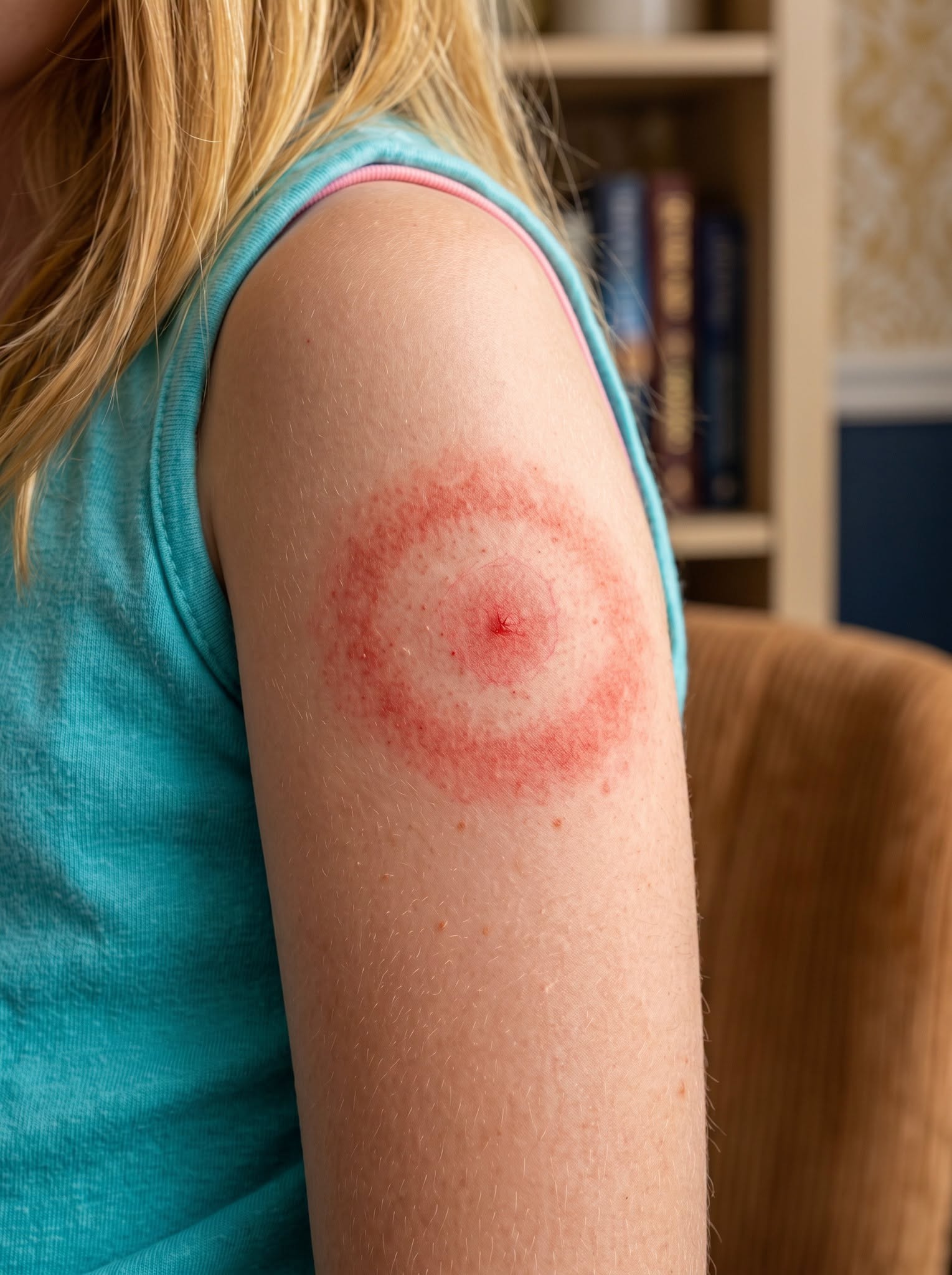
A single small spot that appeared suddenly and isn’t causing your child to feel sick may be less alarming than a rapidly spreading rash accompanied by other symptoms.
For example, a mildly itchy localized patch after spending time outdoors could be consistent with a minor insect reaction.
But here’s the important part:
Reassuring doesn’t mean diagnosed.
If you don’t know what caused the rash, watch how it changes.
Take a photo when you first notice it and, if appropriate, another later. This can help you and your child’s healthcare professional see whether the size or appearance is changing.
You can even place a small ruler beside the rash when photographing it so there’s a reference for its size.
How to Keep an Eye on a Ring-Shaped Rash
You don’t need to spend the entire day staring at your child’s arm.
A simple observation routine is enough.
Take a Clear Photo
Photograph the rash in good lighting.
Try to include enough surrounding skin to show its location and overall appearance.
Note the Size
Record roughly how wide it is.
If the rash grows, you’ll have an objective comparison instead of relying on memory.
Watch for New Symptoms
Pay attention to:
- Fever
- Increasing pain
- Itching
- Swelling
- Warmth
- Drainage
- New rashes
- Changes in energy or behavior
Think About Recent Exposures
Ask yourself whether your child recently:
- Played outdoors
- Went hiking or camping
- Had contact with pets
- Shared sports equipment
- Used a new soap or lotion
- Wore new clothing
- Had a possible insect or tick bite
- Came into contact with someone who has a fungal infection
These details can be surprisingly useful when discussing the rash with a healthcare professional.
What Should You Put on the Rash?
This depends on the cause, which is exactly why it’s wise to be cautious.
Avoid experimenting with several different creams at once.
For example, topical corticosteroids can sometimes make certain fungal infections harder to recognize or potentially worse, so using a strong steroid cream simply because the rash is red isn’t a good idea unless a healthcare professional has recommended it.
Likewise, harsh antiseptics, essential oils, or home remedies can irritate already-sensitive skin.
If you’re uncertain about the cause, ask a pharmacist, pediatrician, dermatologist, or other qualified healthcare professional what treatment is appropriate.
Is Ringworm Contagious?
Yes.
Ringworm can spread through direct skin-to-skin contact and through contaminated items such as clothing, towels, bedding, or sports equipment.
Pets can also carry certain dermatophyte fungi and may sometimes be a source of infection.
If ringworm is suspected, avoid sharing towels, clothing, or personal items until you’ve received appropriate advice about treatment and preventing spread.
And remember: having ringworm doesn’t mean anyone did anything wrong.
It’s a common fungal infection, and children can encounter the organisms in many ordinary environments.
Can Pets Give Children Ringworm?
They can.
Cats and dogs can sometimes carry dermatophyte fungi, occasionally without obvious patches of missing fur.
If a child develops a suspicious ring-shaped rash after close contact with a pet—particularly if other family members or pets develop skin lesions—mention that exposure to a healthcare professional.
A veterinarian can also determine whether the animal needs evaluation.
Can a Ring-Shaped Rash Be Eczema?
Yes.
Eczema doesn’t always appear as the stereotypical dry patches people picture.
Some forms of eczema can produce round or coin-shaped patches called nummular eczema.
These spots can be itchy, dry, scaly, and inflamed.
That is one more reason not to assume that every circular rash is ringworm.
A healthcare professional can help distinguish among the possibilities.
What About Granuloma Annulare?
Another possibility is granuloma annulare, a benign inflammatory skin condition that can create ring-shaped or circular patches.
Unlike many fungal rashes, granuloma annulare often doesn’t have the same scaly border.
It may also cause little or no itching.
Still, appearance alone isn’t enough to confidently identify it, especially in a child.
If the ring persists or you’re unsure what you’re seeing, professional evaluation is the best way to get an answer.
Frequently Asked Questions
Does every ring-shaped rash mean ringworm?
No. Ringworm is one possible cause, but insect reactions, eczema, granuloma annulare, allergic reactions, and other skin conditions can also create circular or ring-like patterns.
Is ringworm caused by a worm?
No. Despite the name, ringworm is caused by fungi called dermatophytes.
Can ringworm go away by itself?
It can persist or spread without appropriate treatment, so suspected ringworm should be discussed with a healthcare professional, particularly when it involves a child.
Is ringworm itchy?
It often is, but symptoms vary. Some people experience relatively little itching.
Can my child go to school with ringworm?
Because ringworm can spread through close contact and shared items, follow your healthcare professional’s advice and your school’s policy regarding treatment and attendance.
Should I cover the rash?
That depends on what is causing it and where it is located. If ringworm is suspected, a healthcare professional can advise you about keeping the area covered and reducing transmission.
When should I worry about a red ring on my child’s arm?
Pay particular attention if it is rapidly expanding, painful, hot, significantly swollen, associated with fever or other illness, or follows possible tick exposure. Emergency care is needed for severe allergic symptoms such as trouble breathing or significant swelling of the face, lips, or tongue.
Can I use an antifungal cream right away?
It’s best to confirm or discuss the likely cause before treating an unexplained rash, especially in a child. A pharmacist or healthcare professional can help determine whether an antifungal treatment is appropriate.
General Information
A mysterious red ring on your child’s arm can look dramatic, especially when you first discover it.
But the shape alone doesn’t tell the whole story.
The timing, texture, symptoms, rate of growth, recent exposures, and your child’s overall health all matter.
A small, isolated rash without other concerning symptoms may not require an emergency visit. At the same time, a rash that rapidly expands, becomes painful, appears after possible tick exposure, or comes with fever or other symptoms deserves medical attention.
When in doubt, taking a clear photo and documenting how the rash changes can be incredibly helpful.
And if you’re sitting there thinking, “But it really does look like a perfect little circle!”—I hear you.
Skin has a funny way of making ordinary things look mysterious.
Conclusion
Finding a strange red ring on your daughter’s arm can definitely trigger the parent alarm system.
But before jumping to the worst conclusion, remember that ring-shaped rashes have many possible causes.
It could be a fungal infection such as ringworm, but it could also be an insect reaction, eczema, granuloma annulare, or another type of skin irritation.
The most useful thing you can do is watch the pattern, note any symptoms, consider recent exposures, and seek professional advice when the rash is persistent, spreading, or concerning.
And yes, sometimes you really can breathe a little easier.
Not because you’ve diagnosed the rash from the bathroom mirror—but because you’ve taken a sensible approach, you’re watching for changes, and you know what signs mean it’s time to call the doctor.
If this guide helped you understand a mysterious rash, leave a comment and share it on Pinterest so another worried parent can find it when they need a little reassurance, too.