

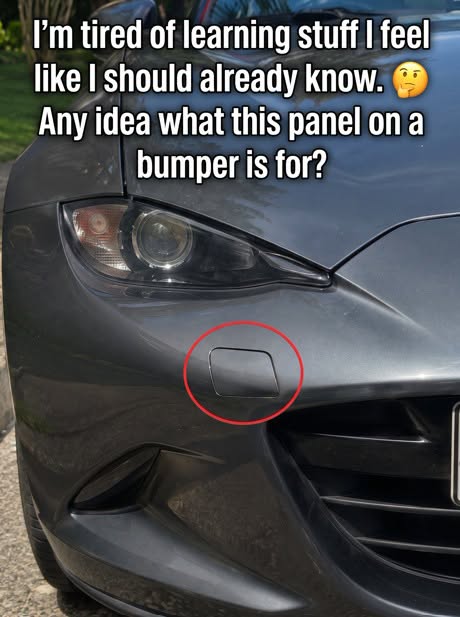
Let’s be honest. Most of us don’t give that tiny, square-shaped panel on the front or rear bumper of our cars a second thought.
It’s just… there.
It blends into the bumper so neatly that you might drive the same car for years without wondering why it exists. It almost looks like a decorative flap with absolutely no purpose.
But here’s the interesting part: that little panel often hides something genuinely useful—a designated towing point for your vehicle.
And once you know what it’s for, you’ll probably start noticing it on cars everywhere!
So buckle up (yes, that pun was intentional), because we’re taking a closer look at this small but surprisingly important piece of automotive design, how it works, and when you might actually need it.
What Is That Small Square Panel on Your Car’s Bumper?
<AsyncImage query=”small rectangular tow hook cover flush mounted front bumper modern passenger car close up” aspectRatio=”16:9″ width=”100%” />
That small square or rectangular panel is usually called a tow hook cover or towing eye cover.
You’ll commonly find it on the front bumper, rear bumper, or both, depending on the vehicle.
At first glance, it looks like an ordinary piece of plastic that matches the color and shape of the bumper. It doesn’t have a visible handle, and there’s no obvious indication that anything is hiding behind it.
But that is precisely the point!
Behind the cover is typically an access point for a removable towing eye, sometimes called a tow hook. On many vehicles, the towing eye screws into a reinforced threaded socket designed for specific towing or recovery situations.
In other words, that little panel isn’t just there for decoration.
It’s covering an access point that can help make towing your vehicle possible without attaching equipment to an unsuitable part of the bumper.
Pretty clever, right?
How Does the Hidden Tow Hook Work?
The system is relatively simple, although the exact design varies between vehicles.
Step 1: Locate the cover
Look for a small, flush-fitting panel on the front or rear bumper.
Some vehicles have one at each end, while others have only one designated access point.