
There are few things that make a parent look twice faster than waking up to discover a strange red ring on their child’s arm.
One minute everything is normal. The next, there’s a perfectly round patch staring back at you from the skin, and your brain immediately starts asking questions.
Is it ringworm?
A bug bite?
An allergic reaction?
Something serious?
Take a breath.
A ring-shaped rash can have several different causes, and the shape alone isn’t enough to tell you exactly what it is. Some are minor and temporary, while others are worth having checked by a healthcare professional.
The good news is that there are some simple clues you can look for—and a few situations where you should seek medical advice sooner rather than later.
If you’re a parent who has ever stood in the bathroom examining a mysterious patch of skin under the brightest light you can find, you’re definitely not alone!
If you enjoy practical family-health articles, subscribe by email so you can have helpful guides like this delivered right to your inbox.
What Does a Ring-Shaped Rash Mean?
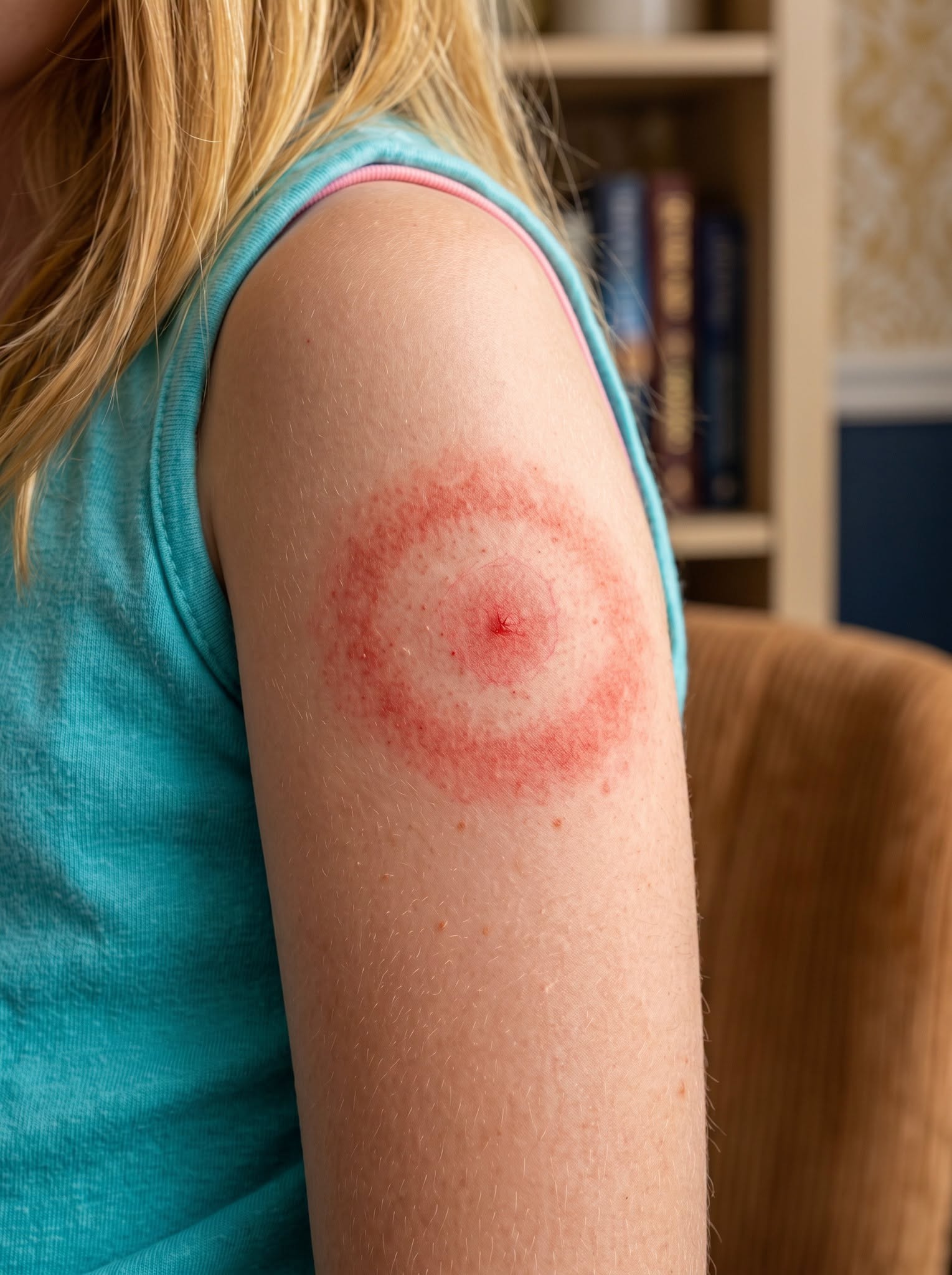
A ring-shaped rash is simply an area of skin that forms a circular or oval pattern.
The center may look relatively normal while the outer edge appears red, raised, scaly, swollen, or irritated.
That pattern can occur with several different skin conditions.
One of the best-known possibilities is ringworm, a common fungal skin infection. But despite its name, ringworm isn’t caused by a worm at all.
Other possibilities include:
- Insect bites
- Contact dermatitis
- Eczema
- Hives
- Granuloma annulare
- Reactions around a healing injury
- Other inflammatory skin conditions
That’s why it’s important not to look at a circular rash and automatically assume it’s ringworm.
Could It Be Ringworm?
It could be.
Ringworm of the body, also called tinea corporis, is a fungal infection that can produce an expanding ring-shaped rash.
It often begins as a small area and gradually enlarges.
The border may be:
- Red or pink
- Slightly raised
- Scaly
- More noticeable than the center
- Itchy
The center can sometimes look clearer than the outer edge, creating the classic “ring” appearance.
But real-life rashes don’t always follow textbook illustrations perfectly.
Some fungal infections can look less obviously circular, and other skin conditions can create surprisingly similar patterns.
What Does Ringworm Usually Feel Like?
Itching is common, although not every child will experience exactly the same symptoms.
A child might say the area:
- Itches
- Feels dry
- Feels irritated
- Burns slightly
- Seems to be spreading
The rash may also slowly become larger over several days.
If the spot is changing in size or developing a more defined, scaly border, it’s worth having it evaluated rather than assuming it will disappear on its own.
Could It Just Be a Bug Bite?
Absolutely.
A bite or sting can sometimes create a circular area of redness around the original spot.
This may be especially likely if the rash appeared suddenly overnight.
A localized insect-bite reaction can be:
- Red
- Swollen
- Itchy
- Warm
- Centered around a small puncture mark
The shape can change as the body’s inflammatory response develops.
A bug bite may also improve over the next few days rather than steadily expanding outward.
However, a rapidly enlarging area of redness shouldn’t automatically be dismissed as a simple bite.
What About Lyme Disease?
This is one of the reasons a new expanding ring-shaped rash deserves some attention.
Lyme disease can cause erythema migrans, a characteristic skin rash that occurs after infection with certain Borrelia bacteria transmitted by infected ticks.
The rash doesn’t always look like the classic “bull’s-eye” people imagine.
It can be uniformly red, circular, oval, or have varying patterns, and it may gradually expand.
If your child has recently been in an area where Lyme disease occurs and may have been exposed to ticks, contact a healthcare professional promptly if an expanding rash develops.
Importantly, you should not rely on whether the rash looks exactly like a bull’s-eye to decide whether medical evaluation is needed.
When Should You Be More Concerned?
Most isolated skin rashes aren’t emergencies.
But certain features deserve more attention.
Seek prompt medical advice if the rash:
- Is rapidly expanding
- Becomes increasingly painful
- Is hot or significantly swollen
- Develops blisters or open sores
- Produces pus or drainage
- Is accompanied by fever
- Appears after a possible tick bite
- Is associated with significant illness or unusual tiredness
- Appears in multiple areas and keeps spreading
- Is accompanied by swelling of the lips, tongue, or face
- Occurs with trouble breathing
If your child has difficulty breathing, significant facial or tongue swelling, fainting, or other signs of a severe allergic reaction, seek emergency medical care immediately.