

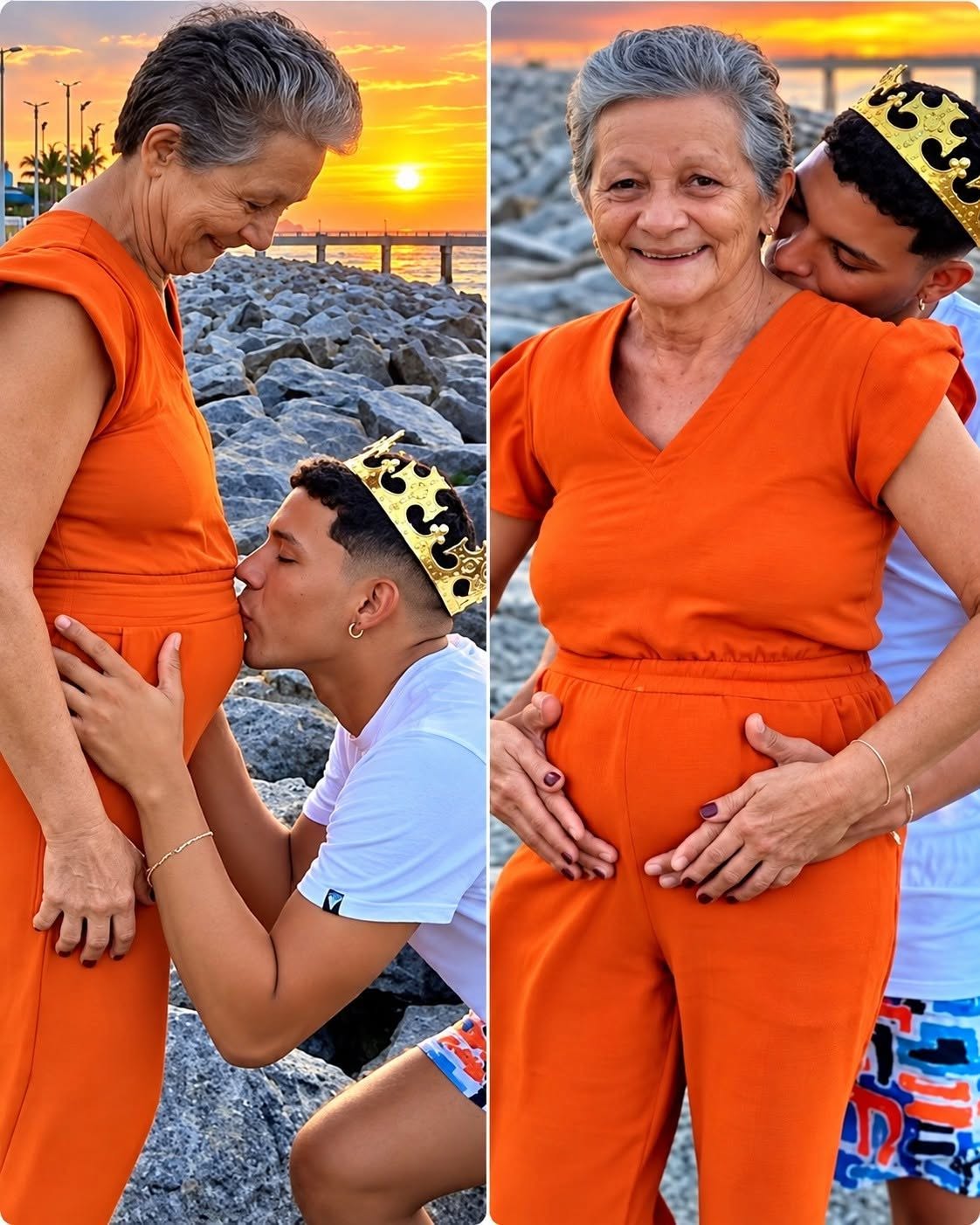
For most people, pregnancy is associated with a particular stage of life. It is something many imagine happening in their twenties or thirties, perhaps later for some, but still within an age range that society generally considers familiar.
So when a 61-year-old woman announced that she was pregnant, the reaction was immediate.
Some people were surprised. Others were skeptical. A few openly questioned whether what she was saying could possibly be true.
Then came the second revelation.
She said the father of the baby was her 25-year-old partner.
Suddenly, the pregnancy was no longer the only thing people were talking about.
The couple found themselves at the center of attention because of their enormous age difference, their decision to have a child together, and the unusual circumstances surrounding the pregnancy.
Yet behind all the comments, questions, and speculation was a woman who said she had made a deeply personal decision about her life—and a younger man who insisted that he intended to stand beside her.
This is a fictional account, created around an unusual pregnancy story and the emotional questions surrounding relationships, age, parenthood, and public judgment.
The Announcement Nobody Expected
The afternoon she decided to tell her family, the 61-year-old woman reportedly spent several hours wondering whether she should say anything at all.
She knew what would happen.
There would be questions.
There would be disbelief.
There would probably be criticism.
And there would almost certainly be people who thought she had made a mistake.
Still, she believed the truth deserved to be spoken.
She had been keeping the news to herself for long enough. Every day that passed made the secret feel heavier.
Finally, she sat down with the people closest to her and told them that she was pregnant.
For several seconds, nobody responded.
The silence was almost louder than an argument.
One relative apparently thought she had misunderstood the medical information. Another assumed she was joking. Someone else simply stared at her, waiting for her to smile and admit that the entire thing had been a misunderstanding.
But she didn’t.
She repeated what she had said.
She was pregnant.
And when the obvious question came—who was the father?—she gave an answer that created an entirely new wave of disbelief.
She said the father was her 25-year-old partner.
The age difference between them was approximately four decades.
That fact alone was enough to make people uncomfortable.
But the pregnancy made everything more complicated.
Suddenly, people who had previously treated their relationship as something unusual began questioning every part of their lives together.
How long had they been together?
Was the relationship serious?
Why would they want to become parents?
Had they considered the challenges?
Was the pregnancy really possible?
And perhaps the most personal question of all:
What made them believe they could build a family together despite such a dramatic difference in age?
The couple said they understood why people were surprised.
But they also said that surprise was not the same thing as knowing what was happening inside their relationship.
A Relationship That Had Already Faced Criticism
Long before the pregnancy announcement, the couple had become accustomed to people noticing their age difference.
A 61-year-old woman and a 25-year-old man naturally attracted attention whenever they appeared together.
Some strangers assumed they were relatives.
Others assumed they were simply friends.
And once people realized they were a couple, reactions varied widely.
There were people who believed their relationship was genuine.
There were others who questioned it.
Some wondered what they could possibly have in common.
The woman said she had learned over time that people often made assumptions about relationships they did not understand.
Her partner felt similarly.
He acknowledged that dating a woman more than three decades older than him was outside what many people considered conventional.
But conventional, he argued, was not necessarily the same thing as meaningful.
They said their relationship had developed through shared experiences, conversations, affection, and emotional support.
They did not claim that the age difference was irrelevant.
In fact, they openly acknowledged that it affected their lives.
They simply believed it did not define everything about them.
That distinction became increasingly important after the pregnancy announcement.
Because once a baby was involved, strangers no longer seemed satisfied with simply questioning their relationship.
They began questioning their ability to become parents.
When Pregnancy Became the Center of Everything
The woman had reportedly experienced symptoms that led her to seek medical attention.
At first, the possibility of pregnancy seemed so unusual that even she struggled to believe it.
At 61, she understood that pregnancy was exceptionally uncommon.
She also understood that there were significant medical concerns associated with pregnancy at an advanced maternal age.
That was why she sought professional medical care rather than relying on assumptions.
According to the fictional account, doctors began conducting examinations and monitoring her condition carefully.
The pregnancy was treated as high-risk.
That meant more appointments, more tests, closer observation, and more discussions about potential complications.
For the woman, the medical appointments became part of her new reality.
For her partner, they became something else entirely.
They became opportunities to demonstrate that he intended to stay.
He attended appointments whenever possible.
He listened when doctors explained potential risks.
He asked questions.
And when his partner became frightened or overwhelmed, he tried to reassure her.
The couple knew that the road ahead would not necessarily be easy.
But they said they wanted to face it together.
The Skepticism Became Difficult to Ignore
Outside the doctor’s office, however, the situation was very different.
People who heard about the pregnancy were divided.
Some expressed genuine happiness for the couple.
Others were doubtful.
A few people suggested that the pregnancy could not possibly be real.
The woman’s age became the center of almost every conversation.
Some questioned the size of her abdomen.
Others wondered whether there was another explanation for her appearance.
Because the story was so unusual, people began analyzing photographs, discussing her appearance, and speculating about what was actually happening.
The woman eventually admitted that the constant speculation was emotionally exhausting.
Pregnancy is already a deeply personal experience.
Having strangers debate whether you are actually pregnant can make that experience even more difficult.
But she decided not to respond to every accusation.
Instead, she focused on medical appointments.
She knew that eventually the truth would become clearer.
If the pregnancy was progressing, examinations would reveal it.
If there were problems, doctors would identify them.
There was no need, she believed, to win every argument on the internet.
She simply needed to take care of herself.
The 25-Year-Old Partner Refused to Walk Away
For her 25-year-old partner, the situation was equally complicated.
He knew that many people would question his motives.
Some would wonder why a young man would want to become a father with a woman in her sixties.
Others would question whether the relationship could survive the pressure.
He said he could not control what strangers believed.
What he could control was how he treated his partner.
He promised to remain involved.
That meant attending appointments, helping with practical responsibilities, listening when she was worried, and preparing for the possibility that pregnancy at her age could involve unexpected medical complications.
He also had to confront a question that had probably never seemed urgent before:
What kind of father did he want to become?
At 25, he was younger than many first-time fathers.
But becoming a parent has a way of changing the meaning of adulthood.
Suddenly, there were things larger than the couple themselves.
There was a child.
There were medical decisions.
There were financial considerations.
There were questions about childcare, education, family support, and the future.
The couple understood that love alone would not answer every practical question.
They would need planning, patience, medical supervision, and support.
Still, they said they were willing to take those responsibilities seriously.
The Appointment That Changed Everything
Several months into the fictional pregnancy, the couple attended another major examination.
By that point, the woman had become accustomed to the routine.
She would arrive at the hospital or clinic, complete the necessary checks, speak with medical professionals, and wait for results.
But this appointment felt different.
There was more anticipation.
More anxiety.
And more uncertainty.
The couple wanted reassurance that the pregnancy was continuing normally.
When the examination was completed, the doctors reportedly confirmed something that had already become increasingly difficult for outsiders to deny:
She was genuinely pregnant.
The baby appeared to be developing normally at that stage.
For the couple, the confirmation brought enormous relief.
For everyone who had accused the woman of pretending, it represented a dramatic change.
The pregnancy was no longer simply a claim.
There was medical evidence behind it.
The couple did not celebrate the fact that skeptics had been wrong.
Instead, they celebrated the fact that the pregnancy appeared to be progressing.
That distinction mattered to them.
They were not interested in winning an argument.
They wanted a healthy baby.
“Now They Know It’s Real”
After the examination, the woman reportedly felt a mixture of relief and exhaustion.
She had spent months hearing people question her.
Now she had something she had wanted from the beginning: reassurance from her doctors.
Her partner was equally relieved.
He had watched her deal with criticism while simultaneously managing the physical and emotional demands of pregnancy.
The confirmation allowed them to concentrate more fully on preparing for the months ahead.
They began thinking about practical matters.
Where would the baby sleep?
What would they need?
How would they arrange medical care?
Who could help them?
What would happen after delivery?
The questions multiplied.
Pregnancy has a way of transforming abstract dreams into practical responsibilities.
A couple can imagine having a child for months or years.
But once a pregnancy becomes real, imagination gives way to preparation.
Why the Pregnancy Required Extra Monitoring
In the fictional story, doctors emphasized that the woman’s age made the pregnancy medically complex.
Pregnancy at an advanced maternal age can involve increased risks, which is why close medical supervision may be recommended.
For the woman, that meant appointments became increasingly important.
She had to pay attention to her health.
She needed to report concerning symptoms.
She had to follow medical advice.
And she had to accept that some decisions might be made based on safety rather than convenience.
There were moments when she felt frustrated.
There were days when she simply wanted to enjoy the pregnancy without thinking about statistics or potential complications.
But she understood why the doctors were cautious.
The medical team was not trying to frighten her.
They were trying to identify problems early and protect both mother and baby.
Her partner tried to make the process easier.
He accompanied her when possible.
He helped organize appointments.
He kept track of questions they wanted to ask.
And when she became nervous before an examination, he reminded her that they were taking things one step at a time.
The Emotional Side of an Unusual Pregnancy
The physical side of pregnancy receives most of the attention.
But emotionally, the experience can be just as intense.
For this woman, the pregnancy brought happiness, fear, excitement, uncertainty, and vulnerability.
She knew she was entering a stage of life that many people around her had already left behind.
Friends of her age were becoming grandparents.
Some had retired.
Others were focusing on travel, hobbies, or quieter lives.
She was preparing for midnight feedings, diapers, pediatric appointments, and all the responsibilities that come with caring for a newborn.
There were moments when she wondered whether people would ever understand her decision.
But she said she did not need everyone to understand.
She needed the people closest to her to respect it.
Her partner became especially important during those moments.
The couple said they had learned that relationships are not tested only during dramatic events.
Sometimes they are tested by ordinary uncertainty.
A difficult appointment.
A sleepless night.
An unexpected medical concern.
A disagreement about preparations.
A moment of fear.
Those were the moments when they discovered whether they could truly support one another.
The Age Difference Became a Bigger Conversation
As the pregnancy progressed, the couple’s age difference continued attracting attention.
Some people focused on the number itself.
Forty years is a significant difference.
It means the two partners grew up in different generations.
They experienced different cultural moments.
They may have different memories, expectations, and ideas about the future.
But the couple said relationships cannot always be understood through arithmetic alone.
They acknowledged that their age difference created unique challenges.
The woman was aware that she was older than her partner.
He was aware that she was entering parenthood at an age when many people were already thinking about retirement.
They had discussed these realities.
They had to.
Having a child meant thinking beyond the next few years.
It meant thinking about what life could look like ten, twenty, or even thirty years later.
For the couple, those conversations were uncomfortable at times.
But they were necessary.
Preparing for the Baby
As the due date approached, the couple became increasingly focused on preparation.
They began organizing the baby’s sleeping area.
They discussed names.
They considered what kind of support they would need after delivery.
They prepared clothing and other necessities.
And, perhaps most importantly, they prepared emotionally.
The woman knew that childbirth would not simply be another medical event.
It would be the culmination of months of uncertainty.
Every examination had brought them closer to the moment when they would finally meet the baby.
Her partner described the anticipation as difficult to explain.
He had never imagined that fatherhood would arrive in such unusual circumstances.
But as the due date approached, the unusual nature of the story mattered less to him.
There was simply a baby coming.
And he wanted to be ready.
The Final Weeks Were the Most Intense
As the pregnancy entered its later stages, medical appointments became more frequent.
The doctors continued monitoring the woman’s health and the baby’s development.
Every examination carried a mixture of reassurance and anxiety.
The couple understood that reaching the final weeks was an important milestone.
But they also knew that pregnancy could change quickly.
The woman began experiencing the physical discomforts associated with late pregnancy.
She found ordinary movements more difficult.
Sleep became less comfortable.
Fatigue became more noticeable.
Yet she remained determined.
Her partner tried to help wherever possible.
He handled household tasks.
He accompanied her to appointments.
He made sure they had transportation arranged.
He stayed nearby when she felt nervous.
The couple had spent months hearing people tell them that their situation was impossible.
Now they were approaching the moment when they would discover exactly what the future held.
Doctors Made a Careful Decision About Delivery
Eventually, the medical team discussed delivery plans.
Because of the woman’s age and the high-risk nature of the fictional pregnancy, doctors decided that a planned hospital delivery would provide the most controlled environment.
The decision was not presented as a guarantee that everything would be perfect.
Rather, it was about preparation.
A hospital setting would allow medical professionals to respond quickly if complications arose.
The couple accepted the plan.
They knew that childbirth could never be completely predictable.
But they wanted to minimize avoidable risks.
In the days before delivery, the woman experienced a strange mixture of emotions.
She was excited.
She was frightened.
She was tired.
And she was deeply aware that her life was about to change.
Her partner tried to remain calm.
But privately, he was nervous too.
He knew that becoming a father was no longer an abstract idea.
It was about to happen.
The Day They Had Been Waiting For
When the day of delivery finally arrived, the couple went to the hospital according to the plan.
The atmosphere was completely different from the one surrounding their original pregnancy announcement.
There were no social media arguments.
No strangers questioning them.
No debates about whether the pregnancy was real.
There was only the medical team, the expectant mother, her partner, and the baby they had been waiting for.
The woman later described the experience as overwhelming.
Every month of uncertainty seemed to lead to that single moment.
Her partner remained beside her throughout the process.
He had promised that he would.
And now he was there.
The fictional account describes the delivery as successful, with the baby born healthy after weeks of careful monitoring.
For the couple, the moment was difficult to describe.
They had spent months imagining what their child would look like.
Now they could finally see the baby.
The First Time She Held Her Baby
For the woman, holding the newborn was perhaps the most emotional moment of the entire journey.
She had heard people tell her that her pregnancy was impossible.
She had heard people question her motives.
She had heard people criticize the relationship.
She had heard people speculate about the baby.
But none of those voices mattered in that moment.
She was holding her child.
Her partner stood beside her.
The room was quiet.
And for the first time, the story was no longer about age.
It was about a mother meeting her baby.
She reportedly became emotional as she looked down at the newborn.
The months of uncertainty, medical appointments, criticism, and fear suddenly seemed distant.
She had reached the moment she had hoped for.
She had become a mother again at 61.
The 25-Year-Old Father Faced His Own Emotional Moment
For the 25-year-old man, becoming a father was equally profound.
He had spent months telling people that he intended to remain beside his partner.
Now he was holding his child.
The reality of fatherhood began to settle in.
He was no longer simply a young man involved in an unusual relationship.
He was a father.
That meant responsibility.
It meant protecting another human being.
It meant learning.
It meant making mistakes and correcting them.
And it meant understanding that his life would never be exactly the same again.
He reportedly said that becoming a parent changed his perspective.
Things that once seemed important suddenly felt less significant.
Arguments on social media did not matter.
Strangers’ opinions did not matter.
What mattered was the health of his partner and baby.
Not Everyone Changed Their Opinion
The birth did not magically make every critic disappear.
Some people continued questioning the couple.
Some remained uncomfortable with the age difference.
Others continued debating whether a 61-year-old woman should become a mother.
But the couple said they had stopped trying to convince everyone.
They had learned an important lesson during the pregnancy:
People can have opinions about your life without actually living it.
That did not mean the couple believed criticism was always meaningless.
They acknowledged that some concerns were understandable.
Pregnancy at an advanced age involves genuine medical considerations.
A large age difference can create real challenges.
Parenthood requires serious planning.
Those were legitimate issues to discuss.
But there was a difference between raising thoughtful concerns and attacking people personally.
The couple wanted to focus on the former and ignore the latter.
Their Story Became Less About the Shock
SEE THE NEXT PAGE